Philosopher and educator. I teach people to think for themselves by providing specialised teaching and learning support for individuals, schools and universities.
Ainigma: a riddle. The title of my PhD on Plato, and a fair description of teaching.
The cosmos · Dodecahedron
After Plato’s Timaeus · drag to turn · tap to change
For students & clients
My services
Taking new clients now
Tutoring
drag to turn · tap to change
Pretoria East · South Africa
About me
Also open to teaching and lecturing posts.
I teach because I have seen what happens when students realise they can think for themselves, and that transformation carries into the rest of their lives. Above all, I keep learning from the people I teach.
I joined the Department of Philosophy at the University of Pretoria as a tutor in 2010 and stayed on as assistant lecturer and then head lecturer, teaching first-year classes of around five hundred students and designing four modules from scratch. From 2024 to 2026 I held a postdoctoral research fellowship at the University of Johannesburg on Platonic and African esotericism.
In 2026 I turned to the school classroom. During my Postgraduate Certificate in Education I taught Grade 10 and 11 English at Abbotts College Pretoria East and Hoërskool Garsfontein, and found the same pleasure there that I had found in the lecture hall: watching a room of people start to think together.
Alongside teaching I tutor, give feedback on writing, build study materials, and think things through with people who need a philosopher in the room.
At a glance
PhD in Philosophy (2023), MA and BA Honours cum laude, BA in English Literature and Philosophy, all from the University of Pretoria
Postgraduate Certificate in Education, FET Phase, in progress
Based in Pretoria East, Gauteng; in person or online
In brief
2010 A degree and a first tutorial · BA Humanities in English Literature and Philosophy at the University of Pretoria, and a first year as a philosophy tutor.
2012 Honours, cum laude · BA Honours in Philosophy, cum laude. First paper at a philosophy conference.
2013 First article · Contingency, irony and morality: a critical review of Rorty’s liberal utopia, published in Humanities.
2014 Assistant lecturer · Assistant Lecturer in the Department of Philosophy, University of Pretoria, teaching two first-year modules.
2016 MA, cum laude. Head lecturer · MA in Philosophy, cum laude: Symphonia, Aristotle versus Plato Critiqued. Head lecturer from this year. Co-organised the Aristotle Colloquium for his 2400th birth year.
2017 Journal article · Aristotle’s harmony with Plato on separable and immortal soul, in the South African Journal of Philosophy. Joined the PSSA and the International Society for Neoplatonic Studies. Presented at a Wits workshop on Plato’s Republic.
2018 A module redesigned · Partly redesigned Introduction to Moral and Political Philosophy for business students. UP Doctoral Support Bursary for Ainigma, 2018 to 2020.
2019 A first-year course of my own · Created Introduction to Metaphysics and Epistemology from scratch and ran it as head lecturer for classes of around 500, 2019 to 2021. Still in use at UP.
2020 A paper presented · The Curious Case of Neoplatonic Ritual Magic: a case study in divergent approaches to esoteric religious philosophy, at the PSSA Conference, University of KwaZulu-Natal.
2023 Doctorate · PhD in Philosophy: Ainigma, Plato’s Esotericism in Context. Also taught Philosophy of Medicine to a class of more than 700.
2024 Postdoc at UJ · Postdoctoral Research Fellow at the University of Johannesburg: Platonic and African Esotericism. Designed The (Secret) History of Thought and The Good Life. Workshop on publishing in international journals with Prof Thaddeus Metz.
2025 More papers · Reflexive Esotericism at the PSSA, and Animism, Consilience and the Rights of Nature at the South African Society for Environmental Philosophy.
2026 Into the classroom · PGCE practicums at Hoërskool Garsfontein and Abbotts College Pretoria East. 120-hour TESOL/TEFL. Honours course: Philosophy as a Rite of Rebirth. PSSA paper with Mitchell Black.
Postgraduate Certificate in Education (PGCE), FET Phase University of Pretoria · in progress, 2026
BA Honours in Philosophy, cum laude University of Pretoria · 2012
BA Humanities, majoring in Philosophy and English Literature University of Pretoria · 2010
Certificates and registration
120-hour TESOL/TEFL certificate, World TESOL Academy, issued 6 October 2026 · see the certificate ↗
SACE provisional registration as a student teacher, 2026
Languages: English (home language), Afrikaans (fluent)
Full certified academic record available on request
Learners do their best thinking when they feel known and respected.
I plan most lessons as a three-part arc. First, I wake up what learners already know, often with a vivid scenario or a playful dilemma from their own lives. Then comes a guided exercise where they try something new and are allowed to fail. Finally, they put the new skill to work on a real project or a real issue in the world.
Ten weeks in charge of classes in 2026: three at Hoërskool Garsfontein in May, seven at Abbotts College Pretoria East from July to September. Learners this age respond well to being treated as thinking partners, the way I treat my university students, with content pitched at their age and careful steps towards the curriculum outcomes.
Reading difficult texts closely, building arguments and writing clear, well-structured essays are foundational skills in philosophy, and they make up a large part of what English Home Language asks of learners in Grades 10 to 12. I am used to running courses for cohorts of 500, planning full semesters of lessons and assessments, and marking large volumes of written work fairly and consistently. Tutoring early in my career and honours seminars more recently taught me to work with small groups, so classes of 20 to 40 learners felt natural.
In the classroom I rely on continual informal assessment: quick questioning, short written tasks and quizzes such as Kahoot, which my mentor at Abbotts singled out as a strength. This lets me adjust a lesson while it is still happening.
My full teaching philosophy is in my resume.
PGCE teaching practicum · July to September 2026 · seven weeks · mentor teacher Eben van Dien
95out of 100, mentor assessment
98out of 100, observed lesson
7weeks in charge of classes
Planned and taught Grade 10 and 11 English Home Language, taking charge of classes with guidance from a mentor teacher: and with the Grade 10s; , , the and a with the Grade 11s
Used regular informal assessment to check what learners had understood, from quick questioning to a Kahoot revision gauntlet
Community engagement through the school’s WESSA programme: tended the community garden, helped with a shoe donation outreach to a school in need, and played a key role in organising Book Day, a take-one-leave-one book donation drive
What the assessors said
95 out of 100 in the formal mentor assessment, with full marks for classroom competencies. My mentor noted that I “enhanced the learners’ vocabulary through scaffolding.”
98 out of 100 from my University of Pretoria mentor lecturer for an observed Grade 11 poetry lesson, commending “excellent knowledge and innovative way of using media.”
Several learners gave me farewell gifts and asked me to come back.
PGCE teaching practicum · May 2026 · three weeks · mentor teacher Heloïse van der Spuy
3weeks in charge of classes
2poems, three lessons each
8hours of community engagement
Planned and taught Grade 10 English First Additional Language: (conditionals and prepositions) and , Bernard Levinson’s Too Many Words and Mongane Wally Serote’s The Clothes
Built each poem across three lessons, from a hook in the learners’ own lives to a personal response.
Eight hours of community engagement with the school’s Kersfees in die Winter charity drive
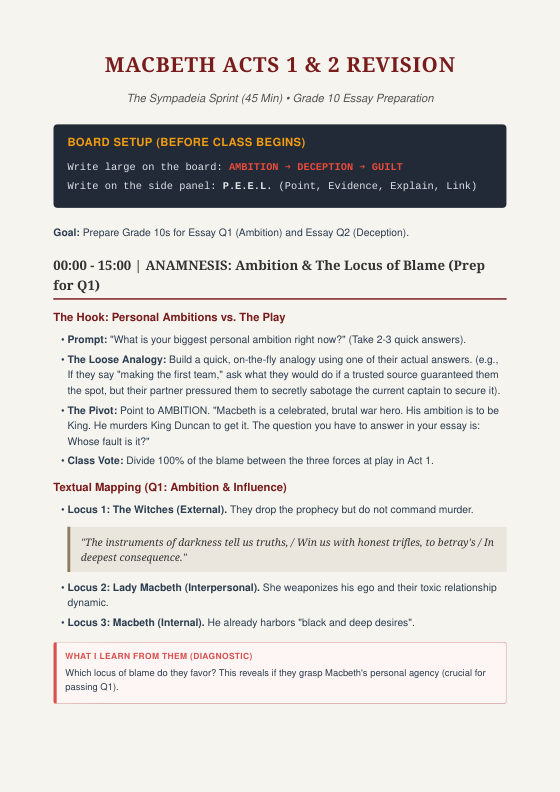
Grade 10 English Home Language · Abbotts College · three classes · August 2026 · Acts 1 to 3
AMBITION → DECEPTION → GUILT
The hook for Act 2 was the night after the murder: horses that broke their stalls and ate each other. From there to Jacobean witch panic, the divine right of kings, and what it means for nature itself to revolt when a king is killed.
Whose fault is it? Each class divided 100% of the blame for Duncan’s murder between the witches, Lady Macbeth and Macbeth himself, then defended the split from the text. The vote showed me at once who had grasped Macbeth’s own agency.
The banquet. For Act 3 Scene 4 the class read in roles, with an empty chair for Banquo’s ghost, and we traced Macbeth’s slide from covert usurper to open tyrant, “in blood stepped in so far”. We skipped Scene 5 and talked about why scholars think Thomas Middleton added it.
Essays. PEEL paragraphs with the school’s rules: no standalone quotes, no “I think”, climb the analysis ladder from literal meaning to word choice to effect to argument.
The lesson at a glance · tap a stage
10Hook10Ambition20The blame debate5PEEL
Hook. Act 2 Scene 4 read aloud and unpacked: darkness at noon, horses eating each other, witchcraft panic, nature in revolt against a king-killer.
Ambition. What is your biggest ambition, and what would you do to get it? Would you betray a friend if you could get away with it, and a partner pushed you?
The blame debate. Three places for the blame: the witches, Lady Macbeth, Macbeth. The class votes and argues from the text, then we turn to deception and guilt.
PEEL. Point, Evidence, Explain, Link: the paragraph structure for the essay, with the school’s rules.
Focusing on the image of the horses eating each other worked very well; it absolutely caught their attention.My reflection after teaching it
A sheet I made for them
A 45-minute revision plan on one page, built around AMBITION → DECEPTION → GUILT, with a quotation bank for Acts 1 and 2 keyed to the two essay questions.
Grade 11 English Home Language · Abbotts College · five classes · July and September 2026
We started with Act 2 Scene 1, where Antonio and Sebastian mock Gonzalo: puns, asides and character foils, read as a study in how clever people bully sincere ones. Then, after the poems and the film study, a scene a day through Act 3.
Faces first. A supercut I cut and subtitled from Julie Taymor’s 2010 film, with the lights down, so every learner could put a face to Prospero, Caliban, Ariel and the nobles before reading. A casting roster for the week went up on the whiteboard.
Act 3 Scene 1. Ferdinand and Miranda read from the front; I read Prospero from the back, watching. Ferdinand carries logs for love, Caliban curses the same work: the difference is choice. The match also wins Prospero back his power.
Act 3 Scene 2. Three chairs for the drunken conspirators. We stopped at “the isle is full of noises” to ask why the “monster” gets the most beautiful verse in the play.
Act 3 Scene 3. Desks pushed into a banquet table, fizzy sweets for the magical feast, thunder and music from a speaker as Ariel the harpy condemned the three men of sin. Corny, and it worked.
Who is Prospero? After the RSC’s 2016 production: a morally ambiguous man, Shakespeare’s own farewell, or a psychomachy in which the island’s creatures are parts of one mind seeking integration.
Revision. A Kahoot gauntlet with a Sleep Token as the prize: the winner earned the right to rest their head through a future lesson.
The lesson at a glance · tap a stage
Act 3, Scene 3 · 4 September 2026
5Hook5Introduction25Body5Consolidation
Hook. I drew little black wings on the whiteboard and physically rearranged the classroom before the learners arrived. I arranged a group of desks into a central banquet table for the nobles, set up the remaining desks in a semi-circle formation around it, and placed fizzy sweets on the central table to act as stand-ins for the magical banquet.
Introduction. I assigned the reading roles and positioned the learners physically in the space. I placed the noble characters at the central banquet table and designated the rest of the classroom in the semi-circle as the surrounding spirits, placing the learner reading Ariel front and centre. I set the context for the scene, explaining that Prospero’s trap for the elites was finally closing after they had been wandering the island in exhaustion and increasing hopelessness and plotting.
Body. We read the scene aloud. I paused to analyse the nobles’ physical exhaustion and Alonso’s despair over his missing son. When we reached the climax of the scene, I triggered dramatic music and thunderstorm effects while Ariel delivered the Harpy speech condemning the “three men of sin.” We broke down the mechanics of the scene, analysing how Prospero used the disappearing banquet and Ariel’s accusations as psychological warfare to drive his enemies to madness.
Consolidation. I wrapped up the lesson by highlighting how this sensory overload broke the nobles’ sanity, leaving them completely at Prospero’s mercy. This immersive reading set them up perfectly for the following Monday, where we would watch the Royal Shakespeare Company execute this exact scene with high-budget stage production.
Two at Hoërskool Garsfontein with Grade 10 First Additional Language learners, three at Abbotts College with Grade 11 Home Language learners. Each one opens here.
· Grade 10 · May
· Grade 10 · May
· Grade 11 · July
· Grade 11 · August
· Grade 11 · August
The method
Read it quietly, then one voice reads it aloud. Guess from the title. A hook from the learners’ own lives. Then the rule I kept repeating: it is not enough to spot a poetic device, you must say what it does in this poem. Groups annotate, I walk the room and check every page.
Bernard Levinson · Grade 10 English First Additional Language · Hoërskool Garsfontein · May 2026 · three lessons
A free-verse poem about the limits of language: how words can exhaust us and act as a veil. The class guessed what it was about from the title, one volunteer read it aloud, and we worked line by line through its imagery by Socratic questioning, treating the poem as something with depth rather than a comprehension exercise.
By the third lesson the learners could identify the devices, explain what they do, and connect the poem’s theme to the way they talk, text and listen.
The lesson at a glance · tap a stage
11 May 2026
5Hook5Introduction15Body5Consolidation
Hook. Bernard Levinson introduced as fascinating pioneer within South African psychology, e.g. pioneer of art therapy and famous experiments on unconsciousness. Pre-reading question on necessity of words for communication, followed by paired one minute of eye contact to illustrate non-verbal communication. Class is then tasked with guessing content of poem based on the title. A volunteer learner reads the entire poem aloud once.
Introduction. Learners asked to explain the concept of “trauma dumping”, to get a feel for the topic of the poem. Poetry analysis framed as way to get more nuance out of their own favourite media pieces.
Body. Poem analysed line by line, open ended questions asked about meaning, specific figures of speech and techniques asked about and then explained. New concept introduced: antithesis.
Consolidation. Assessment anticipated in next lesson. Lesson concluded by encouraging learners to apply analysis to broader text, their favourite music, and so on.
Mongane Wally Serote · Grade 10 English First Additional Language · Hoërskool Garsfontein · May 2026 · three lessons
An elegy from the apartheid years. Before we read, I asked each learner to picture someone they love, the clothes that person always wears, and coming home to find those clothes hanging, knowing the person will never return. Then the poem.
Stanza by stanza: elegy, personification, narrative poem, and the South African “stoep”
The central image, the hanging trousers, which the learners themselves read as a violent and hopeless death: suicide, or execution
Elision, compound adjectives, and implication: seeing beneath the literal words
The turn at the end: the poet is alive, decorated and writing, and the poem becomes a reason for gratitude. The class closed on one question: what would you be willing to sacrifice for?
The lesson at a glance · tap a stage
18 May 2026
5Hook5Introduction15Body5Consolidation
Hook. The poem is read quietly by all and then out loud by one learner. We are introduced to the gripping story of the life of the poet. I prompt learners to guess what the poem might be about based on the title and the life and circumstances of the poet.
Introduction. I prompt the learners to imagine someone they care about very much, and then recall a set of clothes often worn by them. Then, imagine coming home to see those clothes hanging, but knowing that person will never return - this drives home the emotional resonance of the poem, and primes us to proceed with the analysis. The type and structure of the poem are briefly introduced.
Body. The analysis of the poem proceeds stanza by stanza through dynamic Socratic questioning and activation of prior knowledge. Specific imagery for the first half of the poem is analysed and open discussion is allowed.
Consolidation. Findings and discussion is summarised and learners are primed to expect an assessment in the next lesson.
Finuala Dowling · Grade 11 English Home Language · Abbotts College · July 2026 · two lessons
XENIA
XENIA on the board. The hook was Christopher Nolan’s new film of The Odyssey and the Greek sacred duty of hospitality; the second day it was THEOXENY, being kind to a stranger because they might be a god in disguise. A poem about a toddler leading her unhappy mother across the road to a neighbour who makes tea and says “foeitog”.
Role inversion in the first lines, enjambment, consonance, sibilance, and shifts of mood and tone
The poet’s own life, used carefully: a divorce, a real daughter called Beatrice
Etymology as a habit: learners gain a word and, with it, a way of thinking
The deeply ambiguous ending, and what hospitality means in a country like this one
The lesson at a glance · tap a stage
30 July 2026
5Hook10Introduction25Body5Consolidation
Hook. Write XENIA on the board - introduce Christopher Nolan’s recent film adaptation of The Odyssey as a topical pop culture reference to the concept of hospitality - a key theme in the poem. Explain the etymology of the word as a meta-instruction on gaining vocabulary.
Introduction. Get a baseline of learners’ attitudes and general approach to reading and learning poetry. Learners number poem lines. Learners read the poem quietly to themselves, then one volunteer reads it out loud to the class.
Body. The poem is analysed and open discussion is allowed. First the basic narrative structure of the poem and its use of anecdotes is explored. Then specific poetic devices are identified and explained, including role-inversion in lines 1-3, enjambment and symbolism in the first stanza, and consonance in lines 8-9. New vocabulary is also discussed, with a focus on independent learning by mastering etymological basics.
Consolidation. First half of poem is recapped, next parts of poem are anticipated.
Stephen Gray · Grade 11 English Home Language · Abbotts College · August 2026 · two lessons
RESIDUE
RESIDUE on the board, from the Latin for what stays behind. The learners told stories of memories with a strong smell or taste in them while a small bag of lavender went round the room. Then I read the poem aloud and asked them to listen for the senses.
Identify, then explain: groups found the devices in stanzas 1 and 2 and had to say what each one does; I checked every notebook
Enjambment, imagery, symbolism, metonymy, and the extended metaphor that runs through the whole elegy
Differentiated by design: the stronger readers were sent after the rarer, subtler devices
The last lines read aloud again, and a minute on the residue we each leave in other people
The lesson at a glance · tap a stage
6 August 2026
5Hook10Introduction20Body5Consolidation
Hook. Activation consisted of basically just asking the learners about their past week and weekend, then asking whether they had any particular moments that stood out. This segued into group discussions about memories from their lives with particularly strong sensory components. As this was happening, I passed around a small bag of lavender root, thereby emphasising the theme of the connection between memory and senses.
Introduction. The word RESIDUE was up on the board and we shared some sensory memories. I read the poem aloud to the students and prompted them to pay special attention to the sensory imagery in the poem. Then we unpacked what residue means in this context.
Body. I explained the method of identifying and then explaining poetic devices. In other words, learners were instructed that it is not enough to just notice a poetic device, but that they also need to be able to explain what it achieves in the context of the poem. Then learners worked in groups to find and explain poetic devices, focusing on stanza 1 & 2 for this lesson.
Consolidation. We anticipated the next two stanzas and recapped what we had discovered so far, leaving room for some open discussion. The lesson directly flowed into the next one.
William Shakespeare, from A Midsummer Night’s Dream, Act 5 Scene 1 · Grade 11 · Abbotts College · August 2026
POIESIS
POIESIS on the board before they walked in, and a promise: a break from assessments to study one beautiful poem. It opened with a time-crunch quiz, groups racing to find two devices every few lines, scores held back to build suspense.
A skateboarding giraffe: how a sentence conjures what no eye has seen, and so how speech bypasses reality
Oxymoron (“fine frenzy”), paradox, antithesis; “a local habitation and a name” for “airy nothing”
A square circle: the limits of imagination, and a dilemma. Would you take the power to tell when anyone is lying, if it cost you your imagination?
Xenia and residue again: the three poems tied into one argument about what poetry gives
The lesson at a glance · tap a stage
5Hook10Device hunt15Poiesis15The dilemma
Hook. A break from assessments: one learner reads, I read for rhythm, gut reactions, then the plot of the play in two minutes.
Device hunt. Groups race the clock to find two devices every few lines, following the clue key. Enjambment is a freebie; scores are held back.
Poiesis. Speech is everyday magic: a skateboarding giraffe appears in every head. Line by line, the groups supply the held-back answers.
The dilemma. Xenia, residue, a square circle, and a vote: truth or imagination? Cut right before the bell.
They struggled with the abstract elements, but they resonated strongly with the connections between the three poems.My reflection after teaching it
Grade 10 English First Additional Language · Hoërskool Garsfontein · May 2026
“If I were…”, not “If I was…”
Language structures taught inside meaningful situations rather than as isolated rules, so that what is learnt can actually be used.
The first conditional: real plans and likely consequences, with the grammar unpacked in depth once the learners were already using it
The second conditional: imaginary situations. Each learner pitched one decree as dictator of the school for a day, and had to say “If I were…”, not “If I was…”, before the class voted
The third conditional: the impossible past, mapped on the board. If things had gone differently, what would have changed? The hardest of the three to say aloud correctly, and the one that most rewards practice
Prepositions: how one small word shifts meaning and how a listener judges your competence by it
The lesson at a glance · tap a stage
11 May 2026
5Hook10Introduction15Body5Consolidation
Hook. Exciting wager: “I will give everyone in this class R100, IF” pause for effect, point to learner in front row “X can eat their chair before the bell rings”. Conditionals are introduced as ways of navigating deals and imagining different possibilities.
Introduction. The linguistic drift and Latin root are explained before starting with a more in-depth exploration of the grammar of the 1st conditional.
Body. For the 1st conditional, learners are asked to share a recent bargain they struck with their parents, and then state it grammatically correctly in the 1st conditional. Next, learners are asked to say what they would do if they were the principal (correctly stated in the 2nd conditional), with their peers voting on the popularity of their suggestions.
Consolidation. Assessment in next lesson anticipated. Learners are dismissed with exhortation to go and use the 1st and 2nd conditionals to bargain and set better boundaries, and imagine hypotheticals more creatively.
English Home Language · Abbotts College · August 2026 · Grade 11 (five classes) and Grade 10 (three classes)
FRAME
Visual literacy as a language: every detail on a screen was put there on purpose by someone, to tell you something.
Grade 11: the language of film
Camera angles, shot distances, movement and lighting, taught by asking the class what each one makes them feel before giving a definition; then the heavier ideas, denotation and connotation, icons and indexes, and who on a film crew decides what.
The next day, a pub quiz on shots, angles and lighting, in teams with a scribe and a scoreboard, run from PowerPoint’s presenter mode so I could read each scenario aloud before the answer slide appeared.
Grade 10: two films by Miyazaki
Spirited Away. FRAME, a method for writing about a scene: Fact, Rendering, Affect, Meaning, Explanation. We tested it live on No-Face’s rampage, in a world where greed literally turns people into pigs.
Howl’s Moving Castle. Opened with Miyazaki refusing to attend the 2003 Oscars in protest at the invasion of Iraq, then comparative paragraphs and hinge words. The icebreaker: which curse would you rather have?
Assessed by a blog review and a comparative essay; many who had not seen either film had watched both by the next week.
The lesson at a glance · tap a stage
20 August 2026
15Hook5Introduction20Body5Consolidation
Hook. I start the lesson by asking, of course, whether they watched the movie, and ask those that did what they thought of it, especially the protagonist Chihiro, and whether she is a traditional hero. Then I pivot to recapping the opening scenes to emphasise the core themes of the film, including environmental degradation, modernisation, adult hypocrisy and identity.
Introduction. I cover the first slide or two and the FRAME technique, as well as some initial notes on the Blog Review assessment.
Body. We work through the slide deck, with focus at every stage on how Miyazaki uses visual storytelling to achieve affects and meanings. Spirited Away turns out to be an excellent and rich example of this, since the spirit world itself is a place that turns abstract ideas into physical effects (eg greed turning people into literal pigs). Key terms are defined and connected to clear examples.
Consolidation. Learners who have not are strongly encouraged to watch the movie and the one they will be comparing it to, Howl’s Moving Castle. Chihiro’s movement through liminal spaces and navigation of complex adult dynamics are framed as a growing sense of identity and courage and overall symbol for the coming of age story of the film.
Grade 11 English enrichment · Abbotts College · four lessons, taught to five classes · September 2026
In my last month at Abbotts I gave the Grade 11s the tools I give first-years.
Intro to philosophy. “Prove to me that your designated speaker exists.” A minute of paired eye contact. Metaphysics as worldbuilding, epistemology as point of view, and three kinds of illusion in the media they already love, from The Truman Show and The Matrix to Deadpool, ending with a fourth wall broken on one unsuspecting learner.
Intro to ethics. Trolley problems, voted on by a show of hands and compared with how the rest of the internet had voted; then four frameworks, utility, deontology, relational ethics and virtue, each matched to a superhero film: The Batman, Man of Steel, Black Panther and Spider-Man. The closing question: should AI be deleted forever? Argued yes and no through each framework in turn.
Ask me anything. An open Socratic hour, every class different, from gaming and dating to what my generation most misunderstands about theirs, steered at the end to one idea: in a world of algorithmic realities, messy human connection is where the real value lies: in what cannot be automated away.
Mastering English. English as the skill that improves every other skill. How a language shapes what its speakers can imagine, from Orwell’s Newspeak to the hopeful futures of solarpunk fiction; why a mind grows by being challenged; and a class-built list of resources for levelling up, shared with the whole cohort.
The lesson at a glance · tap a stage
31 August 2026
5Hook10Introduction20Body5Consolidation
Hook. I open with a direct question to the class: “What is philosophy?” I deal with some of their preconceptions and introduce the basic concept of the ‘love of wisdom’, before pivoting to introducing them to the feeling of what it is like to do philosophy.
Introduction. The above is followed with a question: “Prove to me that your designated speaker actually exists...” - discuss in groups. This creates cognitive friction and awakens their baseline assumptions about their own sensory reliability, giving them a feel for what doing philosophy actually feels like. Then we do a minute of paired eye-contact, contrasting this phenomenological approach with the more cerebral foregoing discussion.
Body. I introduce the theoretical framework on the board: Metaphysics (Worldbuilding) vs. Epistemology (POV/Perspective). We work through the presentation, scaffolding the three types of illusion (Literal, Symbolic, Meta). Discuss what it actually means to wake up to reality. I draw the distinction between characters breaking the 4th wall for themselves (Truman) versus characters breaking it for the audience (The Tempest).
Consolidation. I end with a rhetorical question about what it would be like to have the 4th wall broken in real life, pivoting to directly addressing a single learner that ‘you’ve been in a coma, we’ve been trying to reach you, wake up’ to make the point hit home, and then relate this to the concept of awakening in wisdom traditions. Finally, I end with a teaser for the next lesson, asking whether or why any of these abstract philosophical considerations actually matter.
Generative AI can now write the kind of essay most classrooms use to teach and to assess. The usual response has been reactive: bans, detection software, policing. That leaves the real question open. If a machine can produce the standard essay, what part of learning cannot be automated, and how should teaching be built around it?
My answer comes from Plato. In the Phaedrus he warned that writing cannot answer for itself: ask a text a question and it only repeats what it says. Philosophy, for him, was dialogue, question and answer between people, which changes the people who take part. That is the part no model can do for a learner, and it is the part I teach.
In my classrooms
Thinking happens out loud. Discussion, Socratic questioning, arguments defended on their feet, reasoning worked through live on the board.
Writing is taught as thinking. Drafted, talked about and revised with feedback, not only handed in and marked.
AI is on the table, openly. We talk about what it is good and bad at, so that learners use it thoughtfully, where it is useful or instructive. With the Grade 11s the closing debate was whether AI should be deleted forever, argued through four ethical frameworks.
Assessment rewards thinking that happens in front of me, in class.
And in my research
My current project, Socratic Pedagogy beyond the AI Horizon, works this out properly: what a Platonic account of learning says about teaching once the essay can be automated, and what to design instead.
I find his account of what cannot be automated in learning more persuasive than most of what I read on the subject.Dr Mitchell-Ron Black, 2026
Wehan is in an excellent position to consider ways of using Platonism to shed light on modern teaching with AI.Prof John F. Finamore, Emeritus Professor of Classics, University of Iowa, 2026
2010tutor at the University of Pretoria
500students in a first-year class
2024postdoctoral fellow at UJ
University of Johannesburg Postdoctoral Research Fellow: Platonic and African Esotericism · April 2024 to April 2026 · hosted and mentored by Dr Asheel Singh
University of Pretoria, Department of Philosophy Head Lecturer (2016, 2018 to 2021, 2023 to 2026) · Assistant Lecturer (2014, 2016 to 2018) · Education Assistant (2015) · Tutor (2010 to 2013). All contract posts.
What the work involved
Head lecturer for first-year, second-year and honours modules, including first-year classes of around 500 students
Designed four modules from scratch and partly redesigned a fifth, writing their study guides, and co-compiled a custom reader
Trained and managed tutor teams, planned lecture schedules and created assessments
Designed marking rubrics and marked thousands of essays and exams
Taught live online and hybrid classes on ClickUP and Blackboard
Service and administration
Contributing member of Footnotes, the philosophy society at the University of Pretoria, from 2010 to 2025: weekly discussions, larger meetings on topical questions, and screenings of philosophical films. It became a formal student association in 2020.
Managed tutor teams as assistant and head lecturer (2014 to 2025), including the tutoring programmes for FIL251 and FIL110, where students work in small groups with dedicated tutors on philosophical reasoning and argumentation
Course management as designer and leader: study guides, assessments, online engagement, student retention and risk management, and guest lecturing opportunities for my tutors and the wider postgraduate community
Played a leading role in organising the election of the first Department of Philosophy Postgraduate Student Representative at UP in 2017
Memberships
Philosophical Society of Southern Africa, since 2017
International Society for Neoplatonic Studies, since 2017
4,000+students lectured
4modules designed from scratch
1partly redesigned
How many students? Counting only the years I lectured and the class sizes on record, the figure is more than 4,000: first-year classes of 485 to 500 in 2017 and 2019 to 2021, two first-year modules in 2014, large second-year ethics classes in 2016 and 2018, a Philosophy of Medicine class of more than 700 in 2023, and the smaller honours and second-year groups since. Four years of tutorials before that are not counted.
Watch me teach
First-year metaphysics · FIL110 · 4 May 2021 · a class of 485
Honours seminar on esotericism · FIL710 · 21 February 2024
Designed from scratch
FIL710 and FIL810 Philosophy as a Rite of Rebirth: From Ancient Egypt to Neoplatonism · Honours · 2026 ·
FIL710 The (Secret) History of Thought: Introduction to Philosophical Esotericism · Honours · 2024 and 2025 ·
FIL220 The Good Life · second year · 2024 ·
FIL110 Introduction to Metaphysics and Epistemology · first year · 2019 to 2021 ·
Partly redesigned
FIL251 Introduction to Moral and Political Philosophy · second year · 2018 ·
Also taught
FIL155 Introduction to the Philosophy of Medicine · first year · 2023
BPE211 Ethics · second year · 2018
FIL110 Introduction to Philosophy: Epistemology and Metaphysics · first year · 2014 and 2017
FIL120 Introduction to Philosophy: Political and Moral Philosophy · first year · 2014
FIL251 Introduction to Moral and Political Philosophy · second year · 2016
Every module I designed came with its own study guide, written from scratch: outcomes, week-by-week structure, readings, assessment plans and student support. Five of them are here to read.
Lovers of Wisdom, a custom reader in two volumes for FIL110, co-compiled with Prof Emma Ruttkamp-Bloem (Cengage, 2019 and 2020)
Living Philosophy, a course package of freely available encyclopaedia entries and primary readings for FIL110 (2021)
The Flourishing Reader, a custom reader for FIL220: The Good Life (2024)
FIL710 and FIL810 · honours study guide · 2026
The course asks what the point of philosophy is, through a close reading of Algis Uždavinys’ Philosophy as a Rite of Rebirth (2008). My most experimental course to date: demanding weekly in-person symposiums, assessments ranging from video essays and podcasts to written work, and a final sit-down essay on the role of philosophy in a world where AI can produce high-quality philosophical content. In the university’s module evaluation, students gave it an average of 4.81 out of 5.
FIL710 · honours study guide · 2024, taught again in 2025
An introduction to philosophical esotericism, literary and ideological. The curriculum introduces different types of esotericism, engages students in close readings of secondary texts on theories of esotericism, and then examines the phenomenon in depth as it appears in the philosophy of Plato.
FIL220 · second-year study guide · 2024 · a class of 59
An undergraduate ethics course on theories of human flourishing, structured around weekly themes such as Gratification, Community, Nature, Salvation and Purpose, and drawing on Greek philosophy, African communitarianism, non-dualism and contemporary virtue ethics. Supported by a custom reader, The Flourishing Reader, and a tutorial programme that develops philosophical writing and argumentation week by week.
FIL110 · first-year study guide · 2021 edition · a class of 485
Created from scratch in 2019 and still in use at the University of Pretoria in 2026. The course traces the history of philosophy around the globe, from prehistoric times and ancient philosophy to contemporary traditions, with a special focus on metaphysics and epistemology: in my estimation an example of what a decolonised philosophy curriculum can look like in practice.
My first foray into curriculum design. The course introduces business students to major ethical theories, including utilitarianism, virtue ethics, Ubuntu and social contract theory, and then immerses them in case studies where those theories meet real life. Two introductory weeks examine ethics and business ethics through South African examples of corruption and State Capture.
Online, I present live and encourage students to chat in the comments as much as they like. The live-stream feel resonates with students, makes the recordings livelier for those watching later, and gives me an easy way to gauge engagement as I teach. I bought my own software and equipment so that my slides and I appear on screen together in good quality.
First-year metaphysics · FIL110 · 4 May 2021 · a class of 485
Honours seminar on esotericism · FIL710 · 21 February 2024
Students, mentors, examiners and colleagues, in their own words, with the numbers behind them.
Students
4.5 out of 5 is my average rating across the eight university courses that had a numerical student evaluation, from a first-year class of 485 to an honours seminar of six.
4.81 Philosophy as a Rite of Rebirth, honours (FIL710 and FIL810) · 2026 · 6 of 6 students
4.71 The Good Life (FIL220) · 2024 · 7 of 59
4.23 Philosophy of Medicine (FIL155) · 2023 · 294 of 734
4.35 Metaphysics and Epistemology (FIL110), online · 2021 · 272 of 485
4.07 Metaphysics and Epistemology (FIL110), the lockdown year · 2020 · 100 of 349
4.6 Metaphysics and Epistemology (FIL110) · 2019 · 147 forms
4.1 Moral and Political Philosophy (FIL251) · 2018 · 191 forms
4.8 Metaphysics and Epistemology (FIL110) · 2017 · 9 forms
Mr Coombs is a fantastic lecturer who manages to explain deep philosophical topics in a manner that is easy to grasp.A first-year student, 2020
Mr Coombs does an incredible job at grabbing our attention and forcing us to truly think and be present. The content is so thought-provoking and I love our assignments.A first-year student, 2023
Professor Coombs is able to explain abstract concepts in a way that makes it easy to understand.A first-year student, 2023
He really knows his work and the way that it is translated in class is very impressive. I truly enjoyed every class that I’ve gone to.A second-year student, 2024
Dr. Coombs is passionate and knowledgeable in his field, he has the ability to simplify complex ideas, which is helpful as a student.An honours student, 2024
One-on-one consultations were especially useful for receiving advice and insights for essays and assignments. Additionally, assignment feedback was always helpful and detailed.An honours student, 2024
The content was by far the most complex and difficult material I have encountered in my academic career so far, but the way in which seminars were presented made it much easier to grapple with.An honours student, 2024
The readings took me on a journey that came full circle in the end. The lessons taught in the module are applicable to all my other modules and has deeply shaped my thinking.An honours student, 2024
It is needless to say this course has been my favorite in honours so far.An honours student, 2025
In a class of 300 Mr Coombs effortlessly attends to questions in the chat while still clearly and concisely going through the course content.A first-year student, online, 2021
All ten evaluations from 2017 to 2026, surveys and emails, are collected in one document with a clickable contents page.
In 2019 I noted that Dr Coombs had the potential to become a brilliant lecturer. In the years since, he has more than fulfilled that potential, at first-year, second-year and honours level, and I recommend him without reservation.Prof Emma Ruttkamp-Bloem, Head of the Department of Philosophy, University of Pretoria · peer evaluation report, 2026
Dr Coombs was in total control of the material and guided and facilitated student learning actively by successfully engaging students in learning.Prof Emma Ruttkamp-Bloem · from her lecture observation
Students describe the seminars as challenging but highly interactive, and comment on his command of the material, his ability to make complex ideas accessible, his availability for consultation and the good organisation of his modules.Prof Emma Ruttkamp-Bloem · on the honours seminars
He is friendly but also firm in terms of discipline.Prof Emma Ruttkamp-Bloem · peer evaluation report, 2026
His dissertation was a careful, scholarly, deep investigation into the Platonic method. Wehan is an excellent teacher and researcher who knows Plato’s philosophy well.Prof John F. Finamore, Emeritus Professor of Classics, University of Iowa · my PhD adviser · recommendation, 2026
Across both papers I have found him a creative and rigorous scholar, and among the most capable early-career philosophers I have worked with. He moves between close readings of Plato and present concerns without flattening either, bringing out the best in the people he works with as he goes along.Dr Mitchell-Ron Black · research collaborator · recommendation, 2026
Without exaggeration, those seminars changed the way I write and engage with the tradition in which I am trained.Dr Mitchell-Ron Black · on the honours seminars he sat in on
I have yet to meet one who does not speak highly of him.Dr Mitchell-Ron Black · on my former students
This is an exceptional thesis. I recommend this thesis receive a PhD without reservation.PhD examiner, Ainigma, 2023
A clear, and indeed distinguished, pass.A second PhD examiner, Ainigma, 2023
Excellent knowledge and innovative way of using media.University of Pretoria mentor lecturer · observed Grade 11 poetry lesson, 2026 · 98 out of 100
Enhanced the learners’ vocabulary through scaffolding.Mentor teacher, Abbotts College Pretoria East · formal assessment, 2026 · 95 out of 100, with full marks for classroom competencies
Referees are listed in my full resume.
Research interests
Plato and the Platonic traditionNeoplatonism and theurgyPhilosophical esotericismAfrican philosophy and decolonial curriculaPhilosophy as a way of life
Publications in peer-reviewed journals
Coombs, W.M. 2017. Aristotle’s harmony with Plato on separable and immortal soul. South African Journal of Philosophy 36(4): 541–552. doi:10.1080/02580136.2017.1385951 Accredited journal on the DHET list, indexed in Scopus.
Coombs, W.M. 2013. Contingency, irony and morality: A critical review of Rorty’s notion of the liberal utopia. Humanities 2(2): 313–327. doi:10.3390/h2020313 Open-access journal published by MDPI, Switzerland.
Thirteen papers at conferences, colloquia and workshops since 2012.
2026 Is Philosophy A(gnostic)? Post-disciplinary Interventions in the Time of Metacrisis · PSSA Annual Conference, University of Cape Town · co-presented with Mitchell Black
2025 Animism, Consilience and the Rights of Nature: South African Conservational Philosophy in the Context of Metacrisis · South African Society for Environmental Philosophy, North-West University · co-presented
2025 Is Philosophy A(gnostic)? Post-disciplinary Insights from Alternative Epistemologies, Decoloniality and Esoteric Studies · Postgraduate Philosophy Symposium, North-West University · co-presented
2025 Reflexive Esotericism: Insights from Literary and Theological Hermeneutics · PSSA Conference, North-West University
2020 The Curious Case of Neoplatonic Ritual Magic: A Case Study in Divergent Approaches to Esoteric Religious Philosophy · PSSA Conference, University of KwaZulu-Natal
2017 Embodiment in Bloom, Plotinus and Iamblichus · Philosophy Postgraduate Association Conference, University of the Western Cape
2017 Immortal and Separable Soul in Aristotle · 42nd PSSA Conference, Rhodes University
2016 Συμφωνία (Symphonia): Recent Debates on ‘Aristotle versus Plato’ · Philosophy Postgraduate Association Conference, Stellenbosch University
2015 Aristotle as Platonist? The Neoplatonic Commentary on Harmony · Philosophy Postgraduate Association Conference, University of the Witwatersrand
2015 Did Aristotle Outgrow Plato · 40th PSSA Conference, Nelson Mandela Metropolitan University
2013 In the Wake of Struggle · 39th PSSA Conference, University of KwaZulu-Natal
2012 The Struggle for Recognition · Philosophy Postgraduate Association Conference, University of Pretoria
Workshops and colloquia
Workshop on publishing in international journals, University of Pretoria (June 2024), led by Prof Thaddeus Metz
Workshop on Laurence Bloom’s The Principle of Non-contradiction in Plato’s Republic, University of the Witwatersrand (2017) · presenter: The Whole Soul’s Goal: Some Apposite Neoplatonic Perspectives on Embodiment
Aristotle Colloquium, University of Pretoria (November 2016), held for Aristotle’s 2400th birth year · member of the organising committee and presenter
My first foray into curriculum design was in 2018, when I redesigned FIL251: Introduction to Moral and Political Philosophy, an enrichment course at the University of Pretoria. The course introduces business students to major ethical theories, including utilitarianism, virtue ethics, Ubuntu and social contract theory, and was built around presenting a theory and then immediately immersing students in case studies where its application to real-life scenarios could be explored. Two introductory weeks focused on understanding the study of ethics and morality in general, and business ethics in particular, through pertinent South African examples of corruption and State Capture. Lecturers who taught it in later years report that pairing theory with topical examples still works.
In 2019 I was given the opportunity to create my own introductory philosophy curriculum from scratch, and so created FIL110: Introduction to Metaphysics and Epistemology, a course still in use at the University of Pretoria today. It traces the history of philosophy around the globe from prehistoric times and ancient philosophy to contemporary traditions, with a special focus on metaphysics and epistemology. Students took to it, and in my view it shows what a decolonised philosophy curriculum can look like in practice. For it I also collaborated with Prof Emma Ruttkamp-Bloem on a custom reader for 2019 and 2020 (Lovers of Wisdom, Cengage), and in 2021 created a bespoke course package of freely available encyclopaedia entries and primary readings, Living Philosophy.
In 2024 I designed two more courses. FIL710: The (Secret) History of Thought: Introduction to Philosophical Esotericism is a postgraduate course exploring the concept of esotericism, both literary and ideological, within philosophy: different types of esotericism, close readings of theories of esotericism, and then the phenomenon in depth as it appears in Plato. FIL220: The Good Life is an undergraduate ethics course on theories of human flourishing, structured around weekly themes such as Gratification, Community, Nature, Salvation and Purpose, and introducing a wide range of traditions, from Greek philosophy and African communitarianism to non-dualism and contemporary virtue ethics. It is supported by a custom reader, The Flourishing Reader, and a structured tutorial programme that develops philosophical writing and argumentation week by week. Both courses are designed around active engagement with primary and secondary texts, and encourage students to examine and develop their own conceptions of meaning, value, and the role of philosophy in life. ·
In 2026 I designed and presented a further honours seminar, FIL710 and FIL810: Philosophy as a Rite of Rebirth: From Ancient Egypt to Neoplatonism. The course asks what the point of philosophy is, through a close reading of Algis Uždavinys’ Philosophy as a Rite of Rebirth (2008). It was my most experimental course to date, with demanding weekly in-person symposiums, punctuated by assessments that included multimodal outputs ranging from video essays and podcasts to written work, and a final sit-down essay that asked students an unseen question about the role of philosophy in a world where AI can produce high-quality philosophical content. In the university’s module evaluation, students gave the course an average of 4.81 out of 5.
Assessment
For introductory courses I train students in analysis and synthesis: memorising and understanding core concepts and facts, and interpreting that information to deliver insightful answers to difficult questions. I use a three-pronged approach. Practical skills in argumentation are taught in tutorials by tutors I coach closely; short questions test insight; and essay questions ask students to explain philosophers’ theories and arguments in their own words. Readings are chosen to give context to the lectures, and I encourage students to read before class, come with questions, review before assessments and practise their reasoning in tutorials.
For small postgraduate groups I set longer essays and regular smaller assessments on the readings, and I take each student’s participation in discussion into account. My long-form postgraduate seminars, usually a weekly three-hour session, encourage direct participation and close reading of difficult material, resulting in lively discussion where I play less the part of a lecturer and more that of a philosophical peer, guiding students to their own insights while bringing out the finer points of each reading and how the readings speak to each other.
Twenty minutes · Tuesday to Thursday · Google Meet · no Google account needed
Pick a time that suits you. We talk through what you need, and afterwards I send a plan, a rate and a start date.
Mornings 09:00 to 12:00 and afternoons 14:00 to 16:00, South African time. If nothing suits, instead.
From R350 an hour · Taking new clients now
English · Philosophy · TEFL
One to one, in person or online
A plan for the term, with marked practice
Online English for non-native speakers
98/100 for an observed Grade 11 lesson, 2026 · “…able to explain abstract concepts in a way that makes it easy to understand.”A first-year student, 2023
What you get
One-to-one sessions, in person in Pretoria East or online, at a regular time
A plan for the term that matches your syllabus or module, and marked practice work between sessions
Exam and essay preparation that builds understanding, not just memory
What I teach
High school English, Grades 10 to 12, Home Language and First Additional Language: literature, poetry and essay writing
University philosophy, from first-year modules to honours
Essay and academic writing at any level: structure, argument and referencing
Online English lessons for non-native speakers, backed by a 120-hour TESOL/TEFL certificate
Why me
Fifteen years of explaining difficult ideas to first-years, and ten weeks in charge of Grade 10 and 11 English classes. I start from what you already know, and I do not move on until it makes sense.
Quoted per project, after a free intro call · Taking new clients now
Workshops on set works, for a class or group
What I taught in 2026
From R450 an hour · Taking new clients now
Essays · Theses
Comments in the margin and a note on what to fix next
The argument first, then the sentences
5 study guides, 2 readers and a course package, written or compiled · “…assignment feedback was always helpful and detailed.”An honours student, 2024
What you get
Your document back with comments in the margin, and a short note on the patterns worth fixing next time
For arguments and drafts: structural feedback first, then comments on the sentences
What I work on
Essays, theses and academic writing
Why me
I have marked and commented on thousands of essays and exams, written five study guides, and put together two readers and a course package. I read for the argument first, then the style.
Quoted per project, after a free intro call · Taking new clients now
Lessons · Modules · Curricula · Tools
One lesson, with all its materials, ready to teach
A whole module, with its study guide
A curriculum, with modules that build on each other
4.81 out of 5, student rating for a module designed from scratch, 2026 · “…the good organisation of his modules.”Prof Emma Ruttkamp-Bloem · peer evaluation report
What you get
A whole module, if you need one: outcomes, a week-by-week structure, readings, assessments and a study guide
Rubrics and marking tools built as simple, standalone web apps that run in a browser
Interactive web apps for learning and practice
Why me
Four university modules designed from scratch and a fifth redesigned, each with its study guide, tutorial programme and assessments, and two years of live online teaching with my own equipment. The five study guides on this page are the kind of thing I make.
Quoted per project, after a free intro call · Taking new clients now
People · Schools · Universities
What to do about AI in your classroom or company
Talks, workshops, a written brief
One to one, for a question of your own
15 years of university philosophy · “He moves between close readings of Plato and present concerns without flattening either…”Dr Mitchell-Ron Black · research collaborator, 2026
Some questions need a philosopher: what a school or team is really for, a hard ethical call, or what to do about AI now that a machine can write the essay, the report and the lesson plan.
For schools, teams and organisations
AI, thought through. What it should and should not do in your classroom, course or company, and how to teach and assess what it cannot do. Policy, practice and a plan.
Talks, workshops and reading groups on ethics, purpose, AI and the humanities, from a single session to a short series
A written brief you can act on: the question stated properly, the positions worth taking seriously, and a recommendation
For a university: an AI review of a module or a whole department, with a written report, the weak assessments redesigned, and a meeting with your staff to talk it through.
For one person
Philosophical counselling: one-to-one conversations about a question in your own life, such as a hard decision or work that has stopped making sense. In person in Pretoria East or online. It is not therapy; if your question belongs with a psychologist or a doctor, I will say so.
Where I come from
A PhD on Plato, for whom philosophy was the care of the soul, and fifteen years of teaching ethics, metaphysics and the good life to people who had never done philosophy before, including business and medical students. My current research is on .
How it works
Open Details on any service and press Request. It drafts a message with the right questions in it, which you send from your own email app or from Gmail, or copy and send however you like (for Classes and Lectures, book a call instead).
Or , Tuesday to Thursday, on Google Meet
We agree a plan, a rate and a deadline up front, in writing
Sessions in person in Pretoria East or online; written work is returned by the agreed date
I reply within two working days.
R350 an hour is the rate for school English. University-level work costs more.
In-person sessions are in Pretoria East, at a place we agree on.
For writing feedback, email me the document or share a Google Doc link. I quote once I have seen the chapter.
A one-to-one conversation (For You) is R450 an hour.
Rates
Tutoring · From R350 an hour
Writing · From R450 an hour
For You · R450 an hour
Classes and lectures, Design, For Your School, For Your University · quoted per project, after a free intro call
Taking new clients now.
Services
Strengths
Clear, patient explanationClose reading and argumentDetailed, constructive feedbackCourse and materials designOnline teachingReliable deadlines
Every module taught, every paper, the complete teaching portfolio and the addenda, kept up to date as a Google Doc.